
GST Registration: A Complete Guide for Australian Businesses
Registration is an important step for every business in Australia. If your business meets the GST turnover threshold or provides certain services, you need to understand how GST registration works. This guide will help you with everything from who needs to register the documents required, the process and how you can check your GST enrollment ID registration.
Using this free GST calculator can also make things easier when calculating your gst requirements.

What is GST Registration?

It is the process of connecting your business with Australian Taxation Office (ATO). This registration makes your business legally able to charge and collect GST so you can claim GST cridits. Once you registered your business must charge GST on taxable sales, submit BAS and receive GST credits on business costs.
When Registration Is Required
You must register if your business:
- Has an annual turnover of $75k or more ($150,000 for non-profits)
- Offers taxi or ride-sharing services no matter the turnover
- Sells products or services online internationally and meets certain limits
- Is part of a registered business group
Even if your business turnover is below the threshold, you may register voluntarily to claim GST credits.
GST Turnover Threshold Explained
Before registering, it’s important to understand your business turnover.
- The $75,000 threshold is based on your projected annual turnover.
- It includes income from all taxable sales but does not include the GST you charge.
Keeping track of your turnover helps you know when this registration becomes mandatory.
When You Should Register Voluntarily
Voluntary registration can benefit smaller businesses that:
- Want to claim GST back on your business purchases
- Build your business’s trust and reputation with clients and suppliers.
- Plan to expand in the future
If you’re unsure, use our free GST calculator to see how much GST you need to pay.
What You Need Before Registration
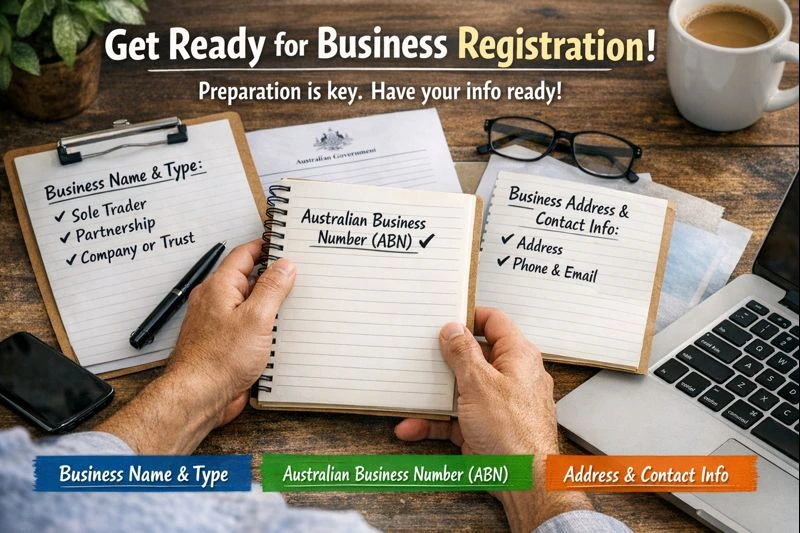
For a smooth registration, preparation is very important. Make sure you have your business info, documents and accounting method ready. You’ll need to share some basic information about your business.
- Business name and type (sole trader, partnership, company or trust)
- Australian Business Number (ABN)
- Provide business address and contact information
Documents and Information Required
Get this documentation ready for verification.
|
Documents |
Purpose |
|---|---|
|
ABN |
Identification of your business |
|
Identity Proof |
Driving License or passport |
|
Bank account details |
For GST payments and Rents |
|
Financial Statements |
For Turnover verification |
Choosing an Accounting Method (Cash vs Accrual)
Choose an accounting method for GST reporting
Cash Accounting: GST is reported when payments are received or paid.
Accrual accounting: GST is reported based on when invoices are sent or received, not when the money is paid.
Your choice determines how GST is calculated on your sales and expenses.
How to Register for GST in Australia
The registration process is an important step for your business. How you register will depend on your type of business and the method you choose.
Here’s an easy guide to help you.
1. Register Online via ATO
The fastest and quickest way is through the ATO online portal:
- Log in with your ABN and business details.
- Fill out the registration form with correct information.
- Upload the required documents for verification.
- Once approved you’ll get your registration ID, which allows you to legally charge and collect GST.
2. Register According to Your Business Type
Every business has its own structures and requires different documents:
- Sole traders: ABN and personal ID
- Partnerships: Provide your ABN and partnership agreement
- Companies: Provide your incorporation documents
- Trust: Provide trustee information and trust deed
Submitting the correct documents helps ensure your application is processed smoothly.
3. Register Through a Tax or BAS Agent
If you want extra help, a registered tax or BAS agent can do the registration for you. They will check your documents, submit the form online and manage the process, which can save you time and avoid mistakes.
Registration Process step by step
- Collect all the required documents for your business type.
- Choose an accounting method for your reporting of GST.
- Log in to the ATO portal or get help from a BAS agent.
- Fill the registration form carefully.
- Submit your documents for verification.
- Receive your GST number and confirmation usually within 2 or 5 business days.
Why This Matters: By completing these steps your business will be legally registered. After Registration, you can add GST on your sales, claim GST credits on business purchases and stay compliant with the ATO rules, which protects your business from fines and penalties.
After Registration Your Ongoing GST Responsibilities
After registering for GST, it’s important to keep things organised. This helps you follow the rules, avoid fines or penalties, and get back any GST credits you’re entitled to. Here’s what you actually need to do:
1. Charge GST Correctly
- Always charge 10% GST to taxable sales.
- Make sure your invoices clearly show the GST so your customers can see exactly how much tax is included.
2. Issue Proper Tax Invoices
- Your tax invoices must include:
- Business name and ABN
- GST amount
- Date and description of goods or services
Accurate invoices are important for your customers to claim GST credits and for your own record keeping.
3. Claim GST Credits
- You can get back the GST you paid on purchases for your business
- Keep all receipts and records organised so that your GST claims are accurate and easy to manage.
4. Lodge BAS or GST Returns
- Submit your Business Activity Statements (BAS) on time monthly, quarterly or annually depending on your business size and reporting cycle.
- Submitting on time helps you follow the rules and avoid fines and penalties.
5. Keep Your Business Records Updated
- Keep your accounting records, financial systems and sales data up to date.
- Having an accurate record makes GST reporting easier, helps you track your taxes and reduces mistakes.
Special Situations and Common Scenarios
New Businesses and Startups
If you expect your turnover to exceed the GST threshold, you’ll need to register. You can also register early if you want to claim GST credits from the start.
Online and International Sellers
If you sell online in Australia or overseas, you may need to register for this if you meet certain limits. A GST calculator can help you estimate what you need to pay.
When Your Business Changes or Closes
If your business details change or you stop trading, make sure to update your registration to stay compliant and avoid penalties.
Tools and Support
ATO Resources and Help Options
The ATO website provides you
- Online portals for registrations
- GST guides and FAQs
- Contact numbers for queries
ITC and GST Estimators
Use GST calculators and ITC estimators to plan payments and claim credits accurately.
Working With Registered Tax or BAS Agents
Agents can handle registrations, lodgment and compliance making it easier for businesses with complex structures.
FAQs
Final Thought
GST registration is important for Australian businesses. Whether it’s required or voluntary, understanding GST helps you stay compliant, avoid penalties and manage your money better. If you have the right documents and good record keeping the process becomes simple and smooth. Using a calculator or getting help from a BAS agent can also make things easier as your business grows.